
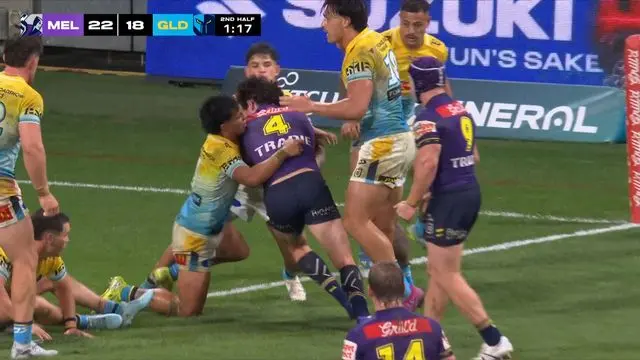
The high-stakes arena of professional rugby league frequently acts as a crucible where athletic excellence, systemic rules, and intense human emotion collide under a microscopic public lens. In a sport defined by its brutal physicality and razor-thin margins of victory, the post-match discourse often shifts from tactical execution to the integrity of the governing systems themselves. A recent clash between the Melbourne Storm and the Gold Coast Titans has provided a stark illustration of this tension, culminating in a profound ideological debate about institutional fairness.

At the center of the unfolding controversy is Titans powerhouse forward Tino Fa’asuamaleaui, whose deep frustration over a critical disallowed goal crystallized into a sweeping, philosophically charged critique of the governing body. His assertion that the “NRL is tolerating fraud” served as a direct challenge to the neutrality of the competition, suggesting a systemic bias toward historically dominant clubs like the Storm. This provocative stance immediately drew a calculated, fifteen-word response from Melbourne captain Harry Grant, setting the stage for a broader examination of power, perception, and justice in modern sport.


To analyze this situation logically, one must first deconstruct the sporting catalyst that triggered such an intense reaction. During a pivotal phase of the match, Fa’asuamaleaui crossed the try line for what appeared to be a crucial score for the Titans. However, upon further review, the on-field match officials and the Bunker—the NRL’s centralized video refereeing system—intervened to disallow the goal, citing a technical infraction in the buildup. To the Titans and their leadership, the decision felt not merely like a strict interpretation of a complex rule, but like an active manifestation of a double standard.
Fa’asuamaleaui’s anger stems from a perception that established powerhouse franchises are routinely granted a degree of leniency and protection that struggling, developing clubs are denied. By labeling the administrative tolerance of these inconsistent decisions as “fraud,” the Titans captain was not necessarily accusing individuals of corruption, but rather arguing that the league’s systemic failure to enforce absolute uniformity across all teams undermines the fundamental integrity of the sport.
The concept of institutional bias, often discussed in sports sociology as “reputation bias,” suggests that elite organizations accumulate a form of cultural capital over decades of sustained success. The Melbourne Storm, under an enduring culture of excellence, have established themselves as the gold standard of the National Rugby League. When a highly contentious, subjective decision occurs on the field, the default psychological assumption by onlookers—and potentially by officials operating under extreme cognitive load—often leans toward validating the actions of the champion.
For an underdog franchise like the Gold Coast Titans, fighting for cultural recognition and competitive parity, a subjective call that goes against them can easily be interpreted as a systemic barrier. Fa’asuamaleaui’s public commentary reflects the exhausting burden of this perceived disparity, framing the disallowed goal not as an isolated human error, but as part of a predictable pattern where the powerful are protected at the expense of the vulnerable.
This ideological rift places the NRL administration in a precarious position regarding its public relations and operational credibility. The league prides itself on a salary cap and a structural framework designed to ensure equal opportunity for all seventeen franchises. However, equality of opportunity does not automatically translate into equality of perception. When a high-profile captain openly questions the fairness of the officiating matrix, it exposes a gap between the institutional narrative of absolute impartiality and the lived experience of the competitors on the field.
The logical deduction from Fa’asuamaleaui’s perspective is that if the governing body does not actively audit and rectify these subtle shifts in officiating behavior, it is implicitly validating an uneven playing field. This is the structural “fraud” he references—the illusion of a perfectly fair competition masking an underlying ecosystem where reputation carries weight.
The narrative took a sharper, highly sophisticated turn when Melbourne Storm captain Harry Grant was asked to address his counterpart’s severe criticisms. Recognizing the volatility of the situation and the danger of fueling a media-driven controversy, Grant chose a path of ultimate restraint and tactical precision. He delivered a concise, fifteen-word message that completely bypassed the emotional trap of an aggressive counter-argument. While his specific words focused entirely on the autonomy of the official processes and the internal standards of his own club, the subtext of his message was unmistakable.
Grant essentially argued that elite status is maintained through a disciplined adherence to the rules as they are enforced, rather than through external administrative favoritism. By limiting his public defense so stringently, the Storm captain effectively neutralized the immediate controversy, refusing to give the narrative the additional media oxygen it required to mutate into a prolonged scandal.
From a strategic standpoint, Grant’s response exemplifies the public relations playbook of an elite organization. Engaging in a protracted debate over whether the league favors certain teams only serves to legitimize the accusation in the eyes of the public. By offering a minimal, highly disciplined statement, Grant shifted the focus back to the objective reality of the match statistics and the official record.
His logic implies that while opponents may choose to debate the philosophy and equity of the governing body, the Melbourne Storm will remain strictly focused on navigating the realities of the game within whatever parameters the officials establish. This contrast in communication styles highlights the deep psychological division between a franchise accustomed to winning and one striving to break through institutional barriers.
Furthermore, this incident underscores the complex relationship between human judgment and the technological systems designed to perfect it. The introduction of high-definition slow-motion replays and the centralized Bunker was intended to eliminate subjectivity and provide an unassailable standard of truth. However, as this match demonstrated, increased technology has not eliminated controversy; it has merely magnified the debate around interpretation. When a video referee reviews an incident from multiple angles and still arrives at a conclusion that deeply alienates one half of the competitors, it proves that rugby league’s rules possess an inherent grey area that technology cannot fully resolve.
This reality lends a layer of rational weight to Fa’asuamaleaui’s frustration, even if his characterization of the system as fraudulent remains an unproven emotional claim.
Ultimately, the dialogue between Tino Fa’asuamaleaui and Harry Grant serves as an insightful exploration of the unspoken power dynamics that influence professional sports. It elevates a standard post-match officiating complaint into a significant discussion about institutional equity, reputation, and the systemic pressures faced by modern athletes. As the NRL administration reviews the match and the subsequent commentary, the underlying questions regarding how institutional identity shapes the perception of fairness will undoubtedly persist, altering how future encounters between these two distinct rugby league cultures are evaluated by commentators and fans alike.
In an era where advanced video technology is utilized to guarantee absolute fairness, do you believe that a club’s historical prestige can still create an unconscious bias in officiating that disadvantages underdog teams, or are systemic critiques like the one leveled by Tino Fa’asuamaleaui simply a natural byproduct of the frustration that arises from the sport’s inherently subjective rules?